Selifan
Dead SoulsSelifan, the coachman in Paul Ivanovitch Chichikov’s household, is both a working servant and a comic force in the novel’s road episodes. His easy intimacy with his three horses, his loquacious reflections, and his failures of judgment repeatedly alter the journey’s course; yet he remains beside his master across changing estates, crises, and seasons, until the two prepare to leave town together after Chichikov’s release.
Identity and Working Life
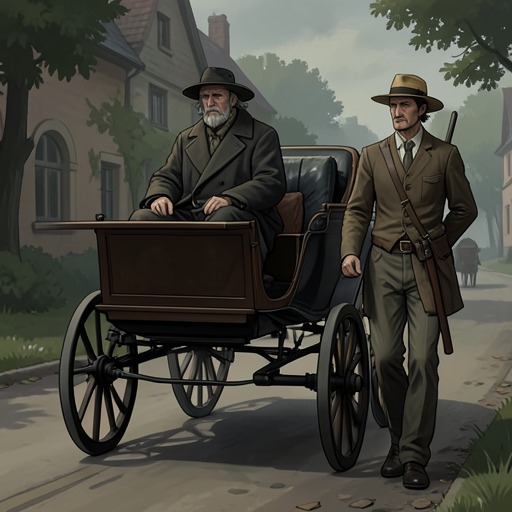
Selifan first appears among the people and possessions arriving with Chichikov at an inn: he is described as a little man in a large overcoat, responsible for the horses while the valet Petrushka settles into the servants’ quarters. The contrast between his small figure and oversized coat gives his entrance a visual economy, while his occupation places him at the practical center of Chichikov’s itinerant life. The master travels in a britchka, but the coachman must keep the team moving, respond to roads and weather, and manage the vehicle’s everyday demands.
The narration repeatedly associates Selifan with the troika’s horses—the bay, the Assessor, and the skewbald—and presents his driving as a mixture of familiarity and unreliability. He addresses the animals as if they could understand a human lecture, distinguishes between those he believes work well and the skewbald, which he thinks only pretends to pull, and even promises the bay extra feed for its diligence. This affectionate, conversational manner makes the horses more than anonymous equipment in the travel scenes: Selifan’s attention turns the working team into a small social world of praise, reproach, and imagined response.
Talk, Temperament, and the Road
After leaving Manilov’s estate, Selifan becomes absorbed in a running monologue to the skewbald. He praises the bay and the Assessor, scolds the skewbald for shaking its ears, and alternates a cut of the whip with gentle strokes across the backs of the other two horses. His familiar talk then turns to the people who had hosted them. He remembers them as agreeable company, says he enjoys conversation and tea with a decent man, and praises Chichikov as a respected former government servant and Collegiate Councillor. The passage makes Selifan’s speech a revealing counterpoint to his master’s inward calculations: while Chichikov is absorbed in his own designs, the coachman’s attention ranges from the team to hospitality and social rank.
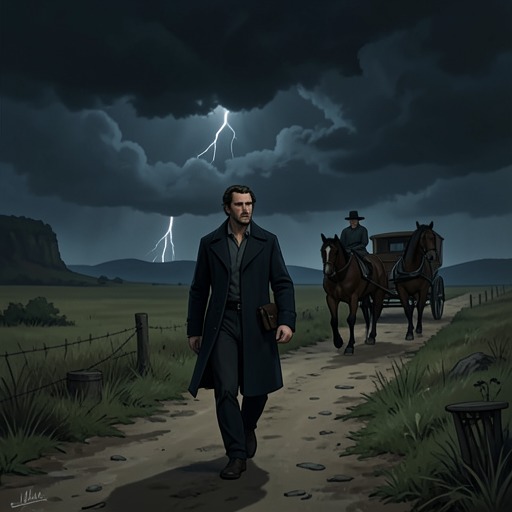
That talk helps explain both Selifan’s charm and the practical danger he presents. A thunderstorm breaks over the road while Chichikov is preoccupied with his thoughts. Rain lashes through the sides of the vehicle, forcing Chichikov to draw the curtains and call for greater speed. Selifan, interrupted mid-harangue, covers his sleeves with an old blanket, takes up the reins, and urges on the horses, which have grown sluggish under the combined effect of the weather and his discourse. He cannot remember whether they have passed two turnings or three; suspecting they have passed many more, he abandons further deliberation and turns right at the next crossing without knowing where the road leads.
The consequences soon become physical. The britchka sways and bumps as it crosses a ploughed field, and Chichikov asks which road Selifan is following. Selifan answers that he does not know, blaming the darkness, which is so complete that he cannot see his whip. The vehicle tilts; Chichikov realizes that the coachman is drunk and cries out for him to stop. Selifan insists that overturning people would be wrong, then turns the vehicle until it capsizes on its side. Chichikov lands in the mud on his hands and knees. The horses are exhausted, and Selifan, after stopping them, rests his hands against the britchka and meditatively reproaches the vehicle for upsetting them. The sequence draws out the gap between his confident speech and his actual command of the road.
Conduct After the Accident
After the mishap, Selifan’s manner changes. He drives gloomily but with conspicuous attention, as he characteristically does after getting drunk. The horses have been cleaned, and a collar that had long let its stuffing protrude has been neatly repaired. On the road, Selifan has little to say: instead of his earlier endearments, he repeatedly tells the team to get on, and he gives the skewbald harsh cuts, even striking it in tender places. The horse is rendered as if wondering what has put its master out. This contrast—between the sociable driver who lectures and praises his team and the sullen driver whose whip replaces conversation—registers a change in his behavior without explaining it away.
Chichikov’s changing fortunes also expose Selifan to other people’s questions. When officials try to establish their master’s identity by questioning the servants, Petrushka offers little beyond the smell of his living quarters, while Selifan confines his answer to the fact that Chichikov had been in government employment and had also served in the Customs. The reply supplies only a fragment of a career, leaving the officials no wiser about the business that has made them suspicious. Selifan is therefore not an interpreter of Chichikov’s schemes; his role in the investigation is limited to the sparse, occupational account he can give.
Delays, Judgment, and Changing Circumstances
When Chichikov decides to leave town in haste, he orders Selifan to be up at daybreak and to have the britchka cleaned and ready for a six o’clock departure. Selifan agrees but leaves the room slowly, stopping to scratch his head. The narrator declines to assign a single meaning to that gesture, noting that such a scratch may mean any one of a hundred things. The uncertainty suits Selifan’s place in the story: his thoughts are not made fully legible, even when his actions matter directly to the journey.
The planned departure immediately runs into trouble. Chichikov oversleeps; when he gets up, neither the harnessed britchka nor the preparations are ready. Selifan’s explanation is that the horses need shoeing, a fact that enrages Chichikov because it has not been reported earlier. Ordered to fetch a blacksmith and have everything put right within two hours, Selifan pauses at the door to make a further proposal: Chichikov should consider selling the skewbald, which he judges a cunning, useless animal and more hindrance than help. Chichikov rejects the idea of going to the market at that moment. Selifan’s assessment reverses the earlier road scene, where he had blamed the same horse for feigned effort while praising the bay and Assessor; his practical judgment remains entangled with a personal, talkative relationship to the team.
At Tientietnikov’s estate, Selifan finds a different kind of attraction. In the village, evening singing and country dances draw him into the company of the young women. He joins the dancers, moves hand in hand with them, and takes part in the chorus asking to be shown a bridegroom. The experience lingers into sleep and waking: he seems still to be holding white hands and moving in the dance. This episode offers a rare view of Selifan away from immediate service to Chichikov, absorbed instead in the village’s communal recreation. The horses, meanwhile, are comfortable in their individual stalls, with good oats and the ability to see and answer one another across the partitions.
Continuing Service and Narrative Role
Later journeys preserve the household’s comic disorder. When Chichikov wakes amid open country on the way to Colonel Koshkarev’s, he asks whether Selifan found directions; Selifan says that the noise around the carriage prevented him from asking, although Petrushka had asked the other coachman. Approaching the estate, Selifan identifies the colonel by his whiter skin and respectable gentleman’s paunch. His observation is a small example of the practical, bodily criteria through which he reads the world, distinct from the political and financial calculations that occupy Chichikov.
After a visit to Pietukh, excess food leaves Platon unable to mount his horse, so Platon is sent home with one of the host’s grooms and Chichikov and Platon travel in Chichikov’s carriage. On the way to Kostanzhoglo’s estate, Platon gives Selifan directions because the coachman can hardly keep his seat on the box. Petrushka has twice fallen headlong and has to be tied to his perch with a piece of rope. Chichikov’s dry comment is directed at the valet, but the scene places Selifan amid the larger instability of the traveling party: the route continues through a carriage whose passengers and attendants are struggling to remain in place.
Selifan’s story closes another departure. After Chichikov is released from prison, he leaves with a warder carrying his effects and finds Selifan and Petrushka delighted to see him free. Chichikov tells them they must pack and be off. Selifan agrees that they should leave town, adding that the roads will be firmer after the snow and that he is so tired of the place that its sight hurts his eyes. Chichikov sends him to have runners fitted to the koliaska, an adjustment for winter travel. The recurring road motif thus returns in practical form: the journey resumes not through triumph but through packing, altered equipment, and Selifan’s readiness to drive his master away from the town that has become a source of danger and weariness.